
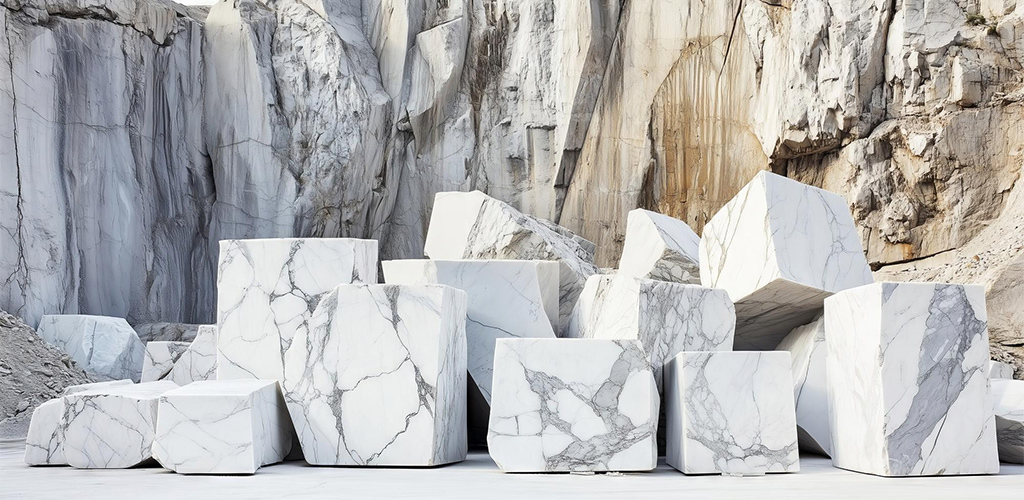
From Quarry to Kitchen: The Journey of Your Countertop Stone
Ever wonder where your countertop actually came from before it landed in your kitchen? The story starts long before any cutting or polishing happens.
For natural stone, that story often begins deep inside the earth, sometimes millions of years in the making. For engineered stone, it starts somewhere very different: a factory floor.
Granite, marble, quartzite, and quartz each take their own path to your home. Here is that journey, step by step.
Where Granite Comes From
Granite forms deep underground, from molten rock called magma. As the magma cools slowly, over thousands or even millions of years, it hardens into the dense, crystalline stone we know as granite.
That slow cooling process is exactly why granite has so much natural variation. Every pocket of magma cools a little differently, which creates the unique specks, veins, and color patterns you see in every slab.
Granite is quarried from massive deposits found around the world, including Brazil, India, China, and parts of the United States. Large blocks are cut directly from the earth using diamond wire saws, and sometimes controlled blasting, before being lifted out in one piece.
Where Marble Comes From
Marble starts out as limestone. Over time, heat and pressure inside the earth transform that limestone into marble, through a natural process called metamorphism.
This is what gives marble its signature soft, flowing veining. The minerals inside shift and recrystallize under pressure, creating those dramatic streaks of color running through an otherwise pale stone.
Marble is quarried in many of the same regions as granite, with Italy, Turkey, and Greece among the most famous sources for high-end marble.
Where Quartzite Comes From
Quartzite shares a similar story with marble, just with a different starting material. It begins as sandstone, and heat and pressure transform it into an extremely hard, durable stone over time.
That transformation is also why quartzite is often harder than granite, while still showing the kind of dramatic, natural movement typically associated with marble.
How Quartz Is Different
Quartz is not quarried at all. It is engineered, right in a factory, from crushed natural quartz combined with resins and pigments.
That manufacturing process is exactly why quartz looks so consistent from slab to slab. There is no waiting on nature here, just a carefully controlled recipe designed for a predictable result every time.
Because quartz is not fully natural, it also skips many of the steps granite and marble go through before ever reaching a fabrication shop. There is no blasting, no massive stone blocks, and no quarry at all.
From Block to Slab
For granite, marble, and quartzite, the next stop after quarrying is a processing plant. Massive stone blocks, sometimes weighing several tons each, are sliced into large, flat slabs using specialized saws.
Each slab is then polished to bring out its natural color and shine. Some finishes stay glossy and reflective, while others are honed for a softer, matte look.
From there, slabs are packed and shipped to distributors and fabricators around the world, including right here in Michigan. A single slab can easily travel thousands of miles before it ever reaches a showroom.
From Slab to Your Kitchen
Once a slab arrives at a fabrication shop like ours, the real customization begins. Every countertop is cut to fit your exact kitchen or bathroom, based on precise on-site measurements.
Edges are shaped, cutouts are made for sinks and cooktops, and the surface gets one final polish before installation day.
Curious what that final stretch actually looks like? Read our full guide on what to expect during countertop installation.
What Happens to the Leftover Stone
Fabrication almost always leaves behind offcuts and remnants. Rather than going to waste, many of these pieces get a second life.
Smaller remnants are often used for vanity tops, cutting boards, or window sills. In fact, if you purchase a full slab for your project, the leftover pieces are usually yours to keep.
Why the Journey Matters
Knowing where your countertop comes from is not just a fun fact. It actually explains a lot about how the material behaves in your home.
Natural stones like granite, marble, and quartzite carry the fingerprint of the exact spot they were formed. That is why no two slabs are ever quite the same, and why seeing a slab in person matters so much before you commit.
Quartz, on the other hand, offers a level of predictability that natural stone simply cannot promise, since it is built rather than found.
From Quarry To Kitchen
Every countertop we install has already traveled a long way, sometimes across the globe, before it ever reaches your kitchen. At American Granite Tops, we help you pick up that journey right where it matters most: choosing the slab that fits your home, and finishing it with the precision it deserves.
We proudly serve homeowners and businesses throughout Metro Detroit, including Oakland, Macomb, Wayne, St. Clair, Livingston, and Genesee counties.
Frequently Asked Questions
How long does it take for stone to form underground?
It varies widely. Granite, marble, and quartzite typically form over thousands to millions of years, through slow natural processes like cooling magma or heat and pressure underground.
Is quartz considered a natural stone?
Not exactly. Quartz countertops are engineered from crushed natural quartz combined with resins and pigments, so they are considered an engineered stone rather than a fully natural one.
Why does granite look different in every slab?
Granite forms as magma cools slowly underground, and no two pockets of magma cool in exactly the same way. That natural variation is what creates the unique colors and patterns in every slab.
Where does most countertop stone come from?
Popular sources include Brazil, India, China, Italy, and Turkey, though granite and marble are quarried in many countries around the world, including parts of the United States.
Does knowing where stone comes from affect my buying decision?
It can. Natural stone varies from slab to slab, so seeing yours in person before installation is worth doing. Engineered quartz, on the other hand, offers more predictable, consistent results if that matters more to you.
Do I get to keep the leftover pieces from my slab?
Usually, yes. If you purchase a full slab, the remnants are typically yours to keep, and they can be handy for a future vanity top, cutting board, or small project.