Commercial Countertops: What Restaurants and Businesses Need to Know
Commercial countertops face a different kind of daily life than the ones in a home kitchen. A bar top gets wiped down hundreds of times a day. A restaurant prep counter takes constant knife work, heat, and heavy equipment. Planning for that reality up front makes a real difference in how a commercial countertop holds up.
Here’s what business owners should know before starting a commercial countertop project.
Durability Comes First
In a home kitchen, durability matters. In a commercial space, it’s the deciding factor.
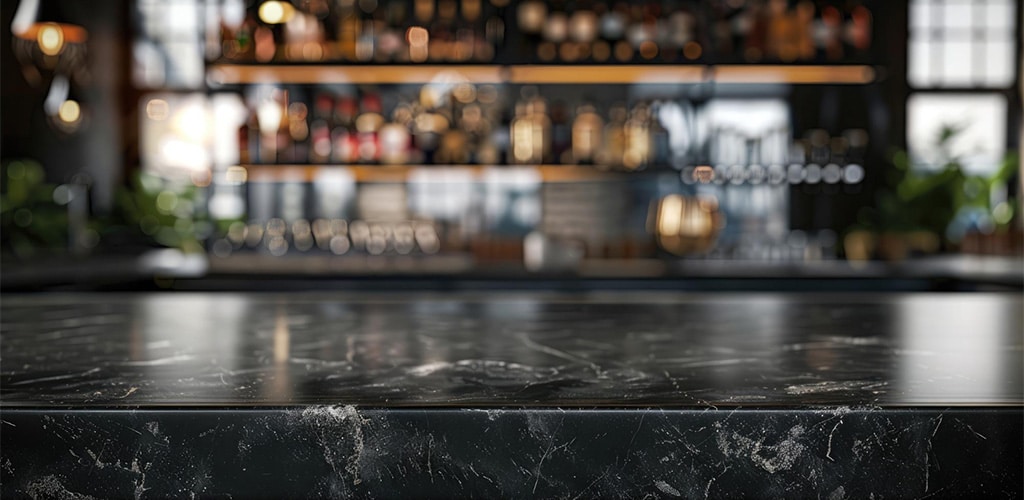
Granite and quartz both hold up well under heavy daily use, but the right choice often depends on the specific application. A quartz bar top, for example, resists the constant moisture, spills, and wipe-downs of a busy service area without ever needing to be sealed. A prep line closer to open flame and hot cookware may call for the extra heat resistance natural granite provides.
Whatever the material, commercial spaces benefit from choosing colors and patterns that hide daily wear. A heavily used surface shows scuffs and water spots faster than a countertop that’s only touched a few times a day.
Volume and Layout Are Different
Commercial spaces are often larger and more complex than a typical residential kitchen. A restaurant might need a long bar top, multiple prep stations, host stands, and a back-of-house counter, all fabricated to work together.
That scale changes the planning process. Seams need to be placed carefully across long runs, and layouts often have to work around existing plumbing, electrical, and equipment that can’t easily move. Measuring and templating for a commercial space usually takes more coordination than a single residential kitchen.
Code and Health Requirements
Restaurants and food service businesses generally need to meet specific health code requirements for food preparation surfaces, which can affect material choice, seam sealing, and edge details around sinks and prep areas. Local health departments are the authority here, and requirements can vary by municipality and by the specific use of the space.
It’s worth confirming code requirements early in the process, before materials are ordered, rather than discovering a conflict after fabrication is already underway.
Timeline Considerations for a Business
A home renovation can usually flex around a family’s schedule. A business often can’t afford to be closed any longer than necessary.
Commercial projects benefit from tighter coordination between templating, fabrication, and installation, sometimes scheduled around off-hours or a planned closure window to minimize disruption. Talking through timeline constraints with your fabricator early helps set realistic expectations and avoid surprises.
Working Around Existing Equipment
Restaurant and commercial installations often have to work around equipment that’s expensive or difficult to move: cooking equipment, refrigeration units, plumbing fixtures, or built-in electrical. Cutouts and layouts need to account for all of it precisely, since a measurement error is far more costly to fix around commercial equipment than around a standard kitchen sink.
A Few Materials Worth Considering for Commercial Use
Quartz is a strong choice for bar tops and high-traffic surfaces, since it never needs sealing and resists the moisture and daily wiping a bar sees constantly.
Granite remains a dependable option for prep areas near heat sources, thanks to its natural heat resistance.
Quartzite offers a premium, upscale look for a business that wants a natural stone statement piece, such as a hostess stand or feature counter, with strong durability to match.
Planning a Commercial Project?
Whether it’s a full restaurant build-out, a bar top replacement, or a new prep line, commercial countertop projects benefit from experience with the scale, coordination, and code requirements involved. We’ve fabricated and installed commercial countertops for restaurants and businesses throughout Metro Detroit, and we’re happy to talk through your specific space and timeline.
We proudly serve businesses throughout Oakland, Macomb, Wayne, St. Clair, Livingston, and Genesee counties.
Frequently Asked Questions
What's the best countertop material for a restaurant bar top?
Quartz is a popular choice for bar tops because it never needs sealing and holds up well to the constant moisture and wiping a busy bar sees every day.
Do commercial countertops need to meet health code requirements?
Often, yes, particularly in food preparation areas. Requirements vary by municipality, so it's worth checking with your local health department early in the planning process.
How long does a commercial countertop installation take?
It depends on the scope of the project, but commercial installations often involve more coordination than a residential kitchen due to larger layouts and the need to work around existing equipment. Discussing your timeline with your fabricator early helps set realistic expectations.
Can commercial countertops be installed around existing equipment?
Yes, but it takes careful measurement and planning, since moving commercial equipment like cooking lines or refrigeration units is often costly or impractical.
Is granite or quartz better for a commercial kitchen?
Both work well, depending on the application. Granite offers strong natural heat resistance for prep areas near cooking equipment, while quartz's low maintenance makes it a favorite for bar tops and other high-traffic surfaces.