
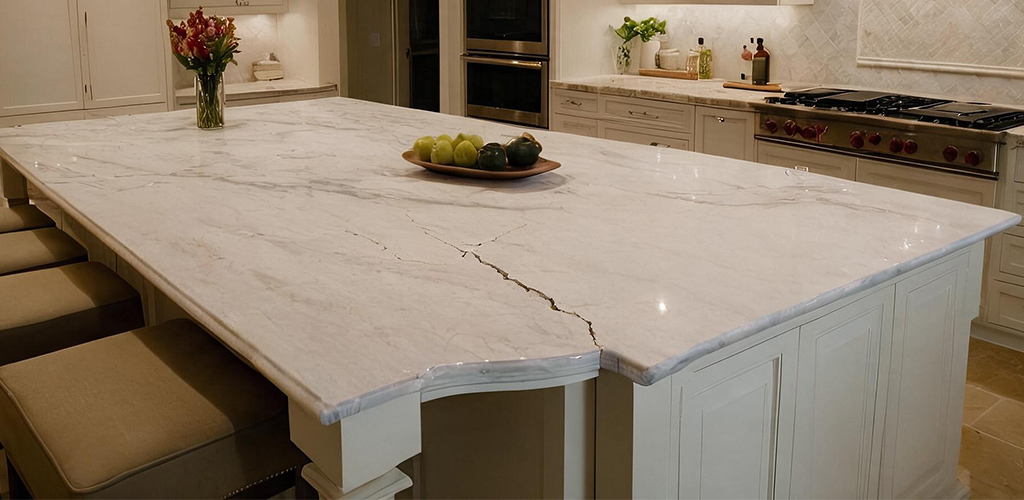
My Countertop Cracked or Has a Defect. What Can I Do?
A crack, chip, or stain showing up on a countertop you’ve been living with for months or years is unsettling, especially when you don’t remember anything obvious happening to cause it. The good news is that most of these issues are common, well understood, and fixable. This guide covers defects that develop over time through normal use, not problems caused by installation itself.
Here’s the short version: small chips and hairline cracks can often be repaired rather than replaced, stains and etching are usually treatable, and the right fix depends entirely on what caused the damage and which material you have. Below, we walk through the most common issues and what to do about each one.
Why Countertops Crack or Chip Over Time
Even durable materials aren’t indestructible, and most post-installation cracks trace back to one of a few causes:
- Impact damage – a heavy pot, cast iron pan, or dropped appliance striking an edge or corner, which is the most common cause of chips.
- Uneven support underneath – if cabinets settle slightly over time, or if a section of countertop (like near a sink or cooktop cutout) isn’t fully supported, stress can build up and eventually cause a crack.
- Thermal shock – placing something very hot directly on the surface, or a sudden temperature change, can stress the stone or engineered material, particularly at seams or thin edges.
- Pressure at weak points – cutouts for sinks, cooktops, and outlets remove material and create naturally thinner, more vulnerable areas. Leaning or sitting on these sections is a common cause of cracking.
- Natural stone fissures – granite and marble can contain natural mineral fissures (fine lines that were always in the stone) that occasionally develop into a visible crack under stress, even though they aren’t a manufacturing defect.
Chips
What it looks like: A small piece missing from an edge or corner, usually from an impact.
What you can do: Small chips are one of the most repairable issues out there. A color-matched epoxy or resin filler, applied and polished by a professional, can make a chip nearly invisible, especially on granite and quartz. For a very small, out-of-sight chip, some homeowners use a DIY stone repair kit, but a professional match will always blend more seamlessly, particularly on visible edges.
Cracks
What it looks like: A visible line, sometimes hairline and sometimes wider, that may or may not go all the way through the slab.
What you can do: This depends heavily on severity.
- Hairline surface cracks can often be filled and stabilized with a color-matched epoxy, similar to a chip repair. This is a job for a professional to get a durable, close-to-invisible result.
- Structural cracks (ones that go through the slab, especially near a sink or cooktop cutout) usually need a more involved repair, such as reinforcing the underside with a support bracket or rod, in addition to filling the visible crack.
- Cracks near seams sometimes indicate the seam itself needs to be reset rather than just filled.
If a crack seems to be growing, or if the countertop flexes or feels unstable when pressure is applied nearby, that’s worth having assessed sooner rather than later. It usually means there’s a support issue underneath, not just a cosmetic problem.
Stains
What it looks like: A dark or discolored patch, often from oil, wine, coffee, or another liquid that sat on the surface.
What you can do: This depends on your material.
- Granite and marble are porous, so stains happen when liquid soaks into the stone rather than sitting on top of it, which is exactly what sealing is meant to prevent. A baking-soda-and-water poultice, left on the stain for 24 hours, is the standard first attempt at lifting it out. If the stain persists, it may mean the sealer has worn down and the stone needs to be resealed.
- Quartz is non-porous, so true staining is rare, most marks on quartz sit on the surface rather than soaking in, and can usually be removed with a non-abrasive cleaner rather than a poultice.
Etching (Common on Marble, Sometimes Granite)
What it looks like: A dull, cloudy spot, often where something acidic (lemon juice, vinegar, tomato sauce, wine) sat on the surface. It’s frequently mistaken for a stain, but it’s actually a chemical reaction that dulls the polish, not a mark that soaked in.
What you can do: Light etching can sometimes be buffed out with a marble/granite polishing powder. Deeper etching usually requires professional re-polishing of that section to restore the shine. Prevention is really the best strategy here: wiping up acidic spills promptly makes a bigger difference than any after-the-fact treatment.
DIY Repair vs. Calling a Professional
| Issue | Reasonable to try yourself | Better left to a professional |
|---|---|---|
|
Tiny chip, out of sight |
DIY kit is usually fine |
– |
|
Visible chip on an edge or corner |
– |
Color-matching matters |
|
Hairline surface crack |
– |
Yes, for a durable, near-invisible result |
|
Structural crack near a cutout |
– |
Yes, may need underside reinforcement |
|
Fresh surface stain |
Baking soda poultice worth trying |
If it doesn’t lift after a couple of attempts |
|
Light etching |
Polishing powder worth trying |
Deeper etching or large area |
As a general rule: anything cosmetic and small is worth a DIY attempt first. Anything structural, anything on a highly visible surface where color-matching matters, or anything that doesn’t respond to a first attempt is worth bringing in a professional — a rushed DIY fix on a visible area is harder to correct afterward than the original damage.
Countertop Cracked? When to Call Us
If you’re dealing with a chip, crack, stain, or dull spot on a countertop and you’re not sure whether it’s a quick fix or something more serious, it’s worth having it looked at rather than guessing. At American Granite Tops, we repair and restore granite, quartz, and marble countertops throughout Oakland, Macomb, Wayne, St. Clair, Livingston, and Genesee counties and in many cases, a repair can save you the cost of a full replacement.
Frequently Asked Questions
Can a cracked countertop actually be fixed, or does it need to be replaced?
Most chips and many cracks can be repaired rather than replaced, especially when caught early. Full replacement is usually only necessary for severe structural damage or when a crack runs through a highly visible area where a repair wouldn't blend well.
Why did my countertop crack even though I never dropped anything on it?
The most common causes without a clear impact are pressure near a sink or cooktop cutout, settling in the cabinets underneath, or (for natural stone) an existing fissure that finally gave way under normal stress.
Is a stain on granite permanent?
Not usually. Most surface stains can be lifted with a poultice treatment, and if staining keeps happening, it's often a sign the sealer needs to be reapplied rather than a sign of permanent damage.
How do I know if it's a stain or etching?
Run your finger over the spot. A stain is usually flat to the touch and darker than the surrounding surface. Etching feels the same as the surrounding stone but looks dull or cloudy, and it's almost always caused by something acidic.
Is this covered under warranty?
That depends on your original installation warranty and the cause of the damage — normal wear, accidental impact, and manufacturing defects are typically treated differently. If you're not sure what your warranty covers, it's worth checking your paperwork or reaching out to whoever installed the countertop.