
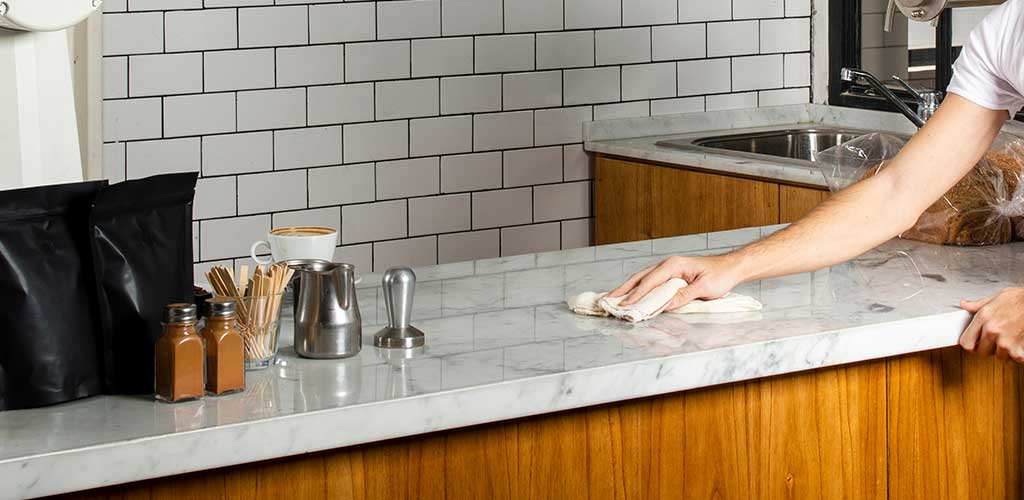
How to Clean and Care for Your Countertop, by Material
Here’s how to clean and care for your countertop, whatever material you have. Good news first: cleaning a countertop the right way is simple once you know a few basics.
How to Clean and Care for Your Countertop, Material by Material
Granite
Granite is durable, but it’s porous, which means daily care matters more than people expect.
Daily cleaning: Warm water and a few drops of mild dish soap, applied with a soft cloth, is really all you need. Rinse and dry the surface afterward so water doesn’t sit on it.
What to avoid: Skip vinegar, bleach, and other acidic or abrasive cleaners. They can wear down the sealant over time and dull the surface.
Sealing: Most granite needs resealing every year or so, though this varies by color and how the stone was finished. A simple test: put a few drops of water on the surface. If it beads up, the seal is still working. If it soaks in, it’s time to reseal.
Quartz
Quartz is engineered to be low maintenance, and it genuinely is, as long as you avoid a couple of common mistakes.
Daily cleaning: Warm water and mild soap, or a gentle non-abrasive cleaner, is enough. Because quartz is non-porous, spills wipe away easily without soaking in.
What to avoid: Bleach and harsh chemical cleaners can discolor the resin in quartz over time. Direct high heat, like a hot pan straight from the stove, can also cause damage, so use a trivet.
Sealing: None needed, ever. This is quartz’s biggest advantage over natural stone.
Marble
Marble is the most beautiful and the most delicate of the common countertop materials, so it earns the gentlest care routine on this list. Here is how to clean and care for your marble countertop.
Daily cleaning: Use only a pH-neutral cleaner made for natural stone, or plain warm water with a few drops of mild soap. Wipe up any spill as soon as you notice it, especially anything acidic like wine, coffee, or citrus.
What to avoid: Never use vinegar, lemon, or any acidic cleaner on marble. It reacts almost instantly, leaving a dull, etched mark that isn’t a stain and can’t simply be wiped away.
Sealing: Marble typically needs resealing more often than granite, sometimes twice a year, depending on how much the surface gets used.
Quartzite
Quartzite behaves a lot like granite day to day, since it’s also a dense natural stone, though it’s typically even harder.
Daily cleaning: Warm water and mild soap works well here too. A gentle stone-specific cleaner is a good option for a deeper clean.
What to avoid: Strong acidic cleaners are still best avoided, even though quartzite resists etching better than marble.
Sealing: Follow the same simple water-drop test used for granite to check when it’s time to reseal.
A Few Habits That Help Every Material
Regardless of what’s on your counters, a few small habits go a long way. Here are some somple ways about how to clean and care for your countertop.
- Use a cutting board. No countertop material is meant to be cut on directly.
- Use trivets and hot pads, even on heat-resistant materials like granite and quartzite.
- Wipe up spills promptly, especially anything acidic.
- Avoid abrasive scouring pads, which can dull a polished finish over time.
Already Dealing with a Stain or Mark?
Daily care prevents most problems, but if something’s already happened, whether it’s a stubborn stain, a dull etched spot, or a small chip, our guide on countertop cracks and defects walks through what’s fixable and how.
We proudly serve homeowners and businesses throughout Oakland, Macomb, Wayne, St. Clair, Livingston, and Genesee counties.
Frequently Asked Questions
What's the safest everyday cleaner for any countertop?
Warm water with a few drops of mild dish soap is safe for granite, quartz, quartzite, and marble alike. It's a reliable default when you're not sure what else to use.
Can I use vinegar to clean my countertop?
Not on natural stone. Vinegar is acidic and can etch or dull granite, marble, and quartzite over time. It's generally fine on quartz, though a plain mild soap works just as well without the risk.
How do I know if my granite needs to be resealed?
Drop a small amount of water on the surface. If it beads up, the seal is still working. If it soaks in within a few minutes, it's time to reseal.
Does quartz ever need sealing?
No. Quartz is non-porous by design, so it never needs to be sealed, which is one of its biggest advantages over natural stone.
Why does marble need more care than granite?
Marble is softer and more reactive to acidic substances than granite, so it etches more easily and typically needs more frequent sealing to stay protected.