
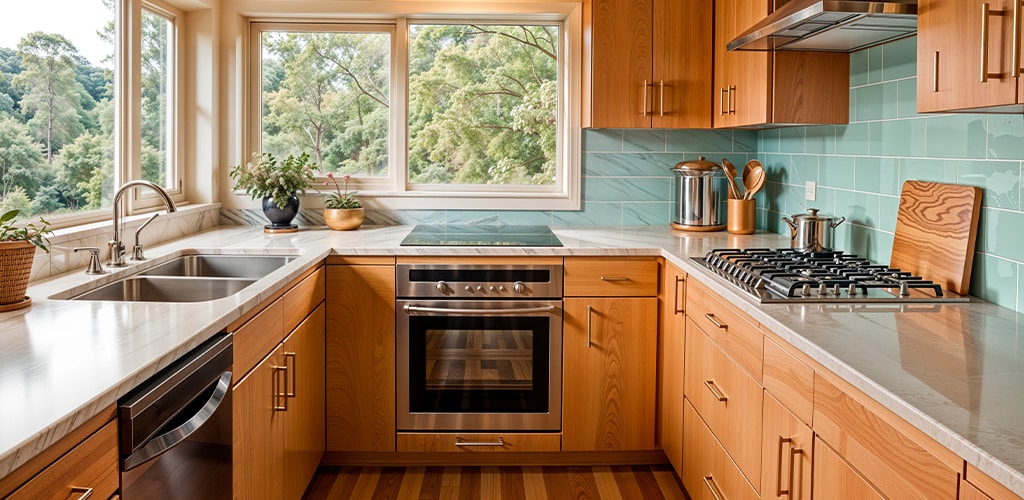
Small Kitchen? Here's How to Choose a Countertop That Works
The short answer: light, low-pattern surfaces with a simple edge and a light-colored backsplash tend to make a small kitchen feel larger, while dark, heavily veined stone and busy edge profiles can make the same space feel tighter. Material still matters for durability, but in a small kitchen, color, pattern, and finish carry a lot of the visual weight. Here’s how to think through each choice.
Why Small Kitchens Need a Different Approach
In a large kitchen, a bold slab with dramatic veining is a focal point with plenty of room to breathe. In a small kitchen, that same slab often becomes the only thing you notice, and it can visually shrink the space. Small kitchens do better with countertops that support the room rather than compete with it. That does not mean boring. It means being intentional about color, pattern scale, and how much contrast is in the room at once.
Color: Light Reads Larger
Light countertops (whites, light grays, soft creams) reflect more light around the room, which helps a small kitchen feel open rather than boxed in. This is especially useful in kitchens with limited natural light or fewer windows.
Darker countertops are not off-limits. A dark surface paired with light cabinets and a light backsplash can still feel balanced, since the contrast is spread around the room instead of concentrated on every surface. The combination to be more careful with is dark countertops with dark cabinets in a small, dim kitchen, which can make the whole room feel smaller than it is.
Pattern: Scale It to the Room
A large-scale, high-contrast pattern (think dramatic marble-look veining) can overwhelm a small countertop run. In a compact kitchen, a subtle, more uniform pattern usually reads cleaner and lets the eye move through the space instead of stopping at the counter.
If you love a bold pattern, one option is to use it in a smaller dose, such as a kitchen island or a backsplash, while keeping the main countertop run quieter.
Finish: Polished vs. Matte
Polished surfaces reflect light and can make a small kitchen feel a bit brighter and more open, which is often the better default in a tight space. Matte finishes are a great look and hide fingerprints and water spots well, but they reflect less light, so they read a little more grounded and less airy. Neither is wrong, it is a question of what feeling you want in the room. For more on how the two compare, see our guide to matte vs. polished countertop finishes.
Edge Profile: Keep It Simple
In a small kitchen, a clean, simple edge (such as a straight or eased edge) tends to look tidier and less visually heavy than an ornate, multi-step edge profile. Elaborate edges can work beautifully in larger kitchens where there is more counter and more distance to appreciate the detail, but in a compact space, simplicity usually looks more intentional.
Material Choices That Work Well in Small Kitchens
All of our materials can work in a small kitchen, the difference is mostly in color and pattern selection within each one.
- Quartz offers the widest range of light, low-pattern options with consistent color from slab to slab, which is helpful if your layout uses multiple pieces.
- Granite has natural light options with subtle movement, and since every slab is unique, it is worth seeing the actual piece rather than just a sample chip.
- Marble brings elegance but is porous and softer, worth keeping in mind in a small kitchen where the counters get heavy daily use.
- Quartzite offers a marble-like look with more durability, a nice option if you want that softer veined appearance without some of the maintenance concerns of marble.
Don't Forget the Backsplash and Cabinets
A countertop does not work in isolation. A light countertop paired with a dark, heavy backsplash can undo a lot of the visual benefit, and the reverse is also true. In a small kitchen, it helps to think about the counter, backsplash, and cabinet color as one system rather than choosing each piece separately.
See What Works for Your Space
Every small kitchen is a little different, and the best way to know how a material and color will actually look is to see a real slab in your space, under your lighting. Browse our full range on the materials we use page, or bring us your layout and we will help you narrow it down.
At American Granite Tops, we work with homeowners throughout Oakland, Macomb, Wayne, St. Clair, Livingston, and Genesee counties, including plenty of smaller kitchens where getting the details right matters even more.
Frequently Asked Questions
Does a light countertop actually make a small kitchen look bigger?
It helps. Light surfaces reflect more light around the room, which creates a more open feel. It is not a magic fix on its own, but combined with light cabinets and good lighting, it makes a real difference.
Can I still get a bold, dramatic countertop in a small kitchen?
Yes, just consider using it in a smaller area, like an island or a backsplash accent, rather than across every surface, so it reads as a feature instead of overwhelming the room.
Is quartz or granite better for a small kitchen?
Both work well. Quartz gives you more consistency and a wider range of light, low-pattern options. Granite gives you natural, one-of-a-kind movement in the stone. The better choice depends on the look and maintenance level you want, not the size of your kitchen.
Does the edge profile really make a visible difference in a small space?
Yes, more than people expect. A simple edge keeps the eye moving smoothly along the counter, while an elaborate edge adds visual detail that can make a compact run feel busier.
Should my backsplash match my countertop in a small kitchen?
It does not need to match exactly, but it should coordinate. A light countertop with a light or simple backsplash generally keeps a small kitchen feeling open, while pairing a light counter with a heavy, dark backsplash can cancel out that benefit.