
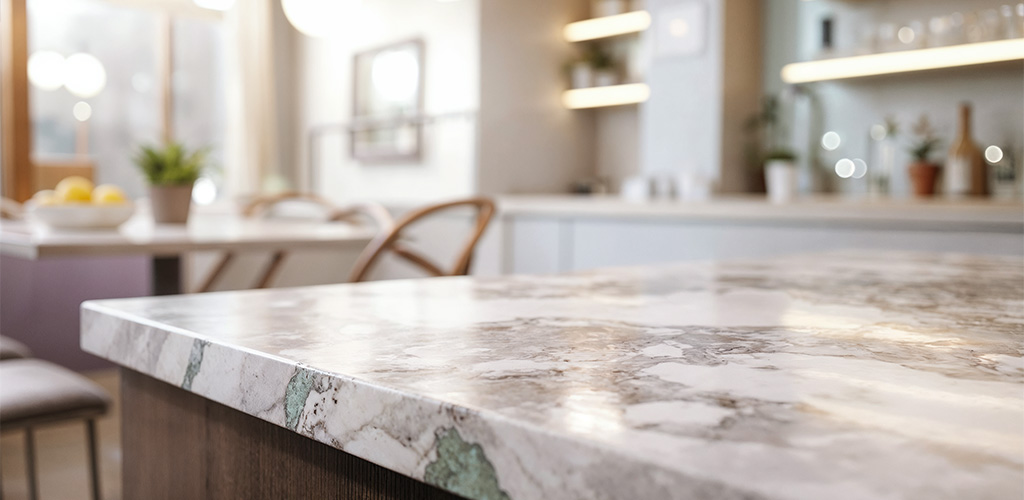
Granite vs. Quartz vs. Marble Countertops: Which Is Right for Your Kitchen?
If you’re planning a kitchen or bathroom remodel, chances are you’ve landed on the same three options everyone else does: granite, quartz, and marble. All three make beautiful countertops, but they behave very differently once they’re actually installed in a working kitchen — and the right choice depends less on which material is “best” and more on how you cook, clean, and live.
Here’s the short version: granite is a natural stone that offers durability and one-of-a-kind veining at a mid-range price point. Quartz is an engineered stone that’s nearly maintenance-free and available in consistent patterns and colors. Marble is the most luxurious-looking option, but it’s also the softest and most prone to staining and etching. Below, we break down exactly how they compare so you can choose with confidence.
Granite Countertops
Granite is quarried in massive blocks, cut into slabs, and polished — which means every single slab is genuinely unique. No two granite countertops look exactly alike, and that natural variation is a big part of its appeal.
Durability: Granite is one of the hardest natural stones used in countertops. It resists scratches, chips, and heat extremely well, which makes it a favorite for people who cook often and aren’t gentle with their kitchen.
Maintenance: Granite is porous, so it needs to be sealed periodically (typically once a year, though this varies by color and finish) to resist stains from oil, wine, and other liquids. With regular sealing, it holds up beautifully for decades.
Appearance: Because it’s natural stone, granite offers dramatic veining, flecks, and color variation that engineered materials can’t fully replicate. If you want a countertop that looks like nothing else in the neighborhood, granite delivers that.
Best for: Homeowners who want natural beauty and top-tier heat/scratch resistance, and don’t mind an occasional resealing.
Quartz Countertops
Quartz countertops are engineered, not quarried — they’re made from roughly 90–95% ground natural quartz combined with resins and pigments. That manufacturing process is what gives quartz its biggest advantages.
Durability: Quartz is extremely hard and highly resistant to scratches and chips. It’s also non-porous, which means it won’t absorb liquids the way natural stone can.
Maintenance: This is where quartz really stands out — it never needs sealing. Soap and water (or a mild cleaner) is all it takes to keep it looking new. For busy households, that’s a meaningful difference over time.
Appearance: Because quartz is engineered, patterns and colors are extremely consistent from slab to slab, which is ideal if you want a uniform, predictable look — or if you’re matching countertops across a large kitchen or multiple rooms. Modern quartz lines also do a convincing job of mimicking the look of natural marble or granite.
A note on heat: Quartz is heat-resistant, but not heat-proof. Because it contains resin, direct contact with very hot pots and pans can cause damage over time, so trivets are still a good habit.
Best for: Homeowners who want a low-maintenance, consistent look and want to skip the annual sealing routine entirely.
Marble Countertops
Marble is the classic choice for a reason — it’s the stone most associated with high-end kitchens and bathrooms, prized for its soft, flowing veining and bright, luminous surface.
Durability: This is marble’s biggest trade-off. It’s a softer stone than granite or quartz, which means it’s more prone to scratching, and it’s more reactive — acidic foods like lemon juice, tomato sauce, and vinegar can etch (dull) the surface if not wiped up quickly.
Maintenance: Marble needs to be sealed regularly, often more frequently than granite, and it rewards a gentler day-to-day routine — quick cleanup of spills, cutting boards instead of cutting directly on the surface, and coasters under glasses.
Appearance: Nothing quite matches marble’s look. Its soft gray or gold veining against a bright white or cream background is why it remains the top choice for statement kitchen islands, bathroom vanities, and fireplace surrounds.
Best for: Homeowners who prioritize timeless, high-end style and are comfortable with a more careful maintenance routine — often paired with granite or quartz elsewhere in the kitchen to balance beauty with everyday durability.
Granite vs Quartz vs Marble
| Granite | Quartz | Marble | |
|---|---|---|---|
|
Material type |
Natural stone |
Engineered stone |
Natural stone |
|
Durability |
Very high |
Very high |
Moderate |
|
Heat resistance |
Excellent |
Good (avoid direct hot pans) |
Good, but can discolor |
|
Stain resistance |
Good with sealing |
Excellent (non-porous) |
Requires care |
|
Sealing required |
Yes, periodically |
No |
Yes, regularly |
|
Pattern consistency |
Unique per slab |
Consistent |
Unique per slab |
|
Best suited for |
Everyday kitchens, heavy use |
Low-maintenance households |
Accent pieces, formal spaces |
So, Which One Should You Choose?
There’s no single “best” material — only the best material for how your household actually uses its kitchen.
- If you cook often, want maximum durability, and love the idea of a truly one-of-a-kind surface, granite is hard to beat.
- If your priority is convenience — no sealing, easy cleanup, consistent color — quartz is likely your best fit.
- If you want the most elevated, high-end look and don’t mind a bit more day-to-day care, marble brings a level of beauty that’s tough to match, especially as an island or accent surface.
Many homeowners in the Metro Detroit area actually mix materials — quartz on the main kitchen counters for everyday durability, with a marble-topped island or bathroom vanity where the extra care is worth it for the look.
Have Questions? We're Happy to Help
At American Granite Tops, we work with granite, quartz, and marble every day — fabricating and installing countertops for kitchens, bathrooms, and fireplace surrounds throughout Oakland, Macomb, Wayne, St. Clair, Livingston, and Genesee counties. If you’re still weighing your options, bring us your ideas (or your Pinterest board) and we’ll help you find the material that fits your space, your budget, and the way you actually use your kitchen.
Frequently Asked Questions
Is quartz more expensive than granite?
Pricing for both materials varies widely based on the specific color, brand, and slab quality you choose, so the two often land in a similar range. The best way to compare is to get quotes on the specific colors you're considering.
Can I put a hot pan directly on quartz?
Not always — it depends on the specific granite color and the sealer used. Some granites hold a seal for several years. A simple water-drop test can tell you if it's time to reseal.
Does granite really need to be sealed every year?
It's best to avoid it. Quartz resists heat better than many materials, but direct contact with very hot cookware can still cause damage over time. A trivet is cheap insurance.
Is marble a bad choice for a kitchen?
Not necessarily — many homeowners use marble successfully, especially with sealing and reasonable care. It's simply a higher-maintenance option than granite or quartz, which is why it's often chosen for an island or accent area rather than the entire kitchen.
Which material adds the most value to a home?
All three are considered premium upgrades and are viewed favorably by buyers. Granite and quartz tend to be the safest "universal" choices for resale, while marble is often appreciated as a luxury accent.